
Stocks vs ETFs vs Index Funds: What's the Difference?
Stocks, ETFs and index funds get used interchangeably, but they're not the same thing. Here's a clear breakdown of each, and how they usually work together.
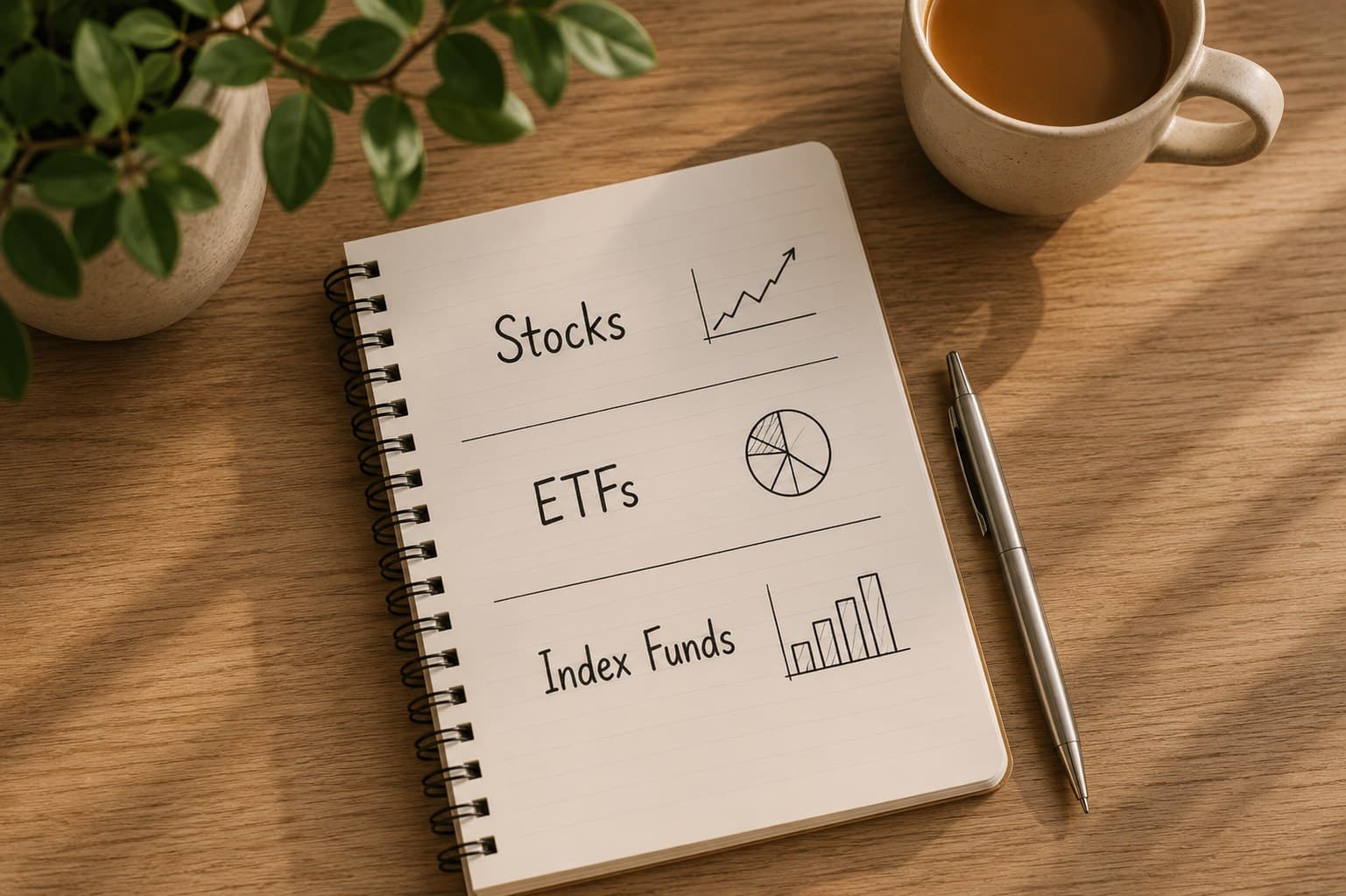
These three terms get thrown around interchangeably, which is exactly why investing can feel more confusing than it needs to be. Here's the actual difference.
A stock is a share in one company. An index fund is a fund that holds many companies to track a whole market. An ETF is a way that fund can be bought and sold on an exchange, like a stock. Many ETFs are index funds, the terms describe different, overlapping things, not competing categories.
Stocks: owning a piece of one company
A stock (or share) represents partial ownership of a single company. If that company performs well, your shares can rise in value; if it performs poorly, they can fall, sometimes sharply. Owning individual stocks concentrates your risk in the fortunes of that one business.
Index funds: owning a piece of an entire market
An index fund pools money from many investors to buy a broad basket of companies, designed to track (or "mirror") a market index, such as the FTSE 100 or the S&P 500, rather than trying to beat it. Instead of betting on one company, you own a small slice of hundreds of companies at once.
This diversification is exactly why index funds are one of the most commonly recommended starting points for beginner investors: one company underperforming barely dents your overall investment.
ETFs: a way funds are bought and sold
ETF stands for exchange-traded fund. It describes how a fund is structured and traded, on an exchange, throughout the trading day, just like an individual stock, rather than what it invests in. An ETF can track an index (making it an index fund too), or it can focus on a specific sector, region or theme.
Note
Think of "index fund" as describing what something invests in (a broad market), and "ETF" as describing how it's bought and sold (like a stock, on an exchange). A single fund can be both an index fund and an ETF at the same time.
Side-by-side comparison
| Stock | Index fund | ETF | |
|---|---|---|---|
| What it represents | One company | A basket of many companies/assets | A structure for trading a fund |
| Diversification | None, single company | High | Varies, often high |
| Typical risk level | Higher (concentrated) | Lower (spread out) | Varies by what it tracks |
| Best suited for | Investors comfortable researching individual companies | Beginners wanting broad, simple exposure | Investors wanting flexible, exchange-traded access to a fund |
Which one should you actually use?
For most beginners, a low-cost, broadly diversified index fund or ETF is a sensible starting point, precisely because it spreads risk across many companies rather than depending on the fate of one. Individual stocks can be added later, in smaller amounts, once you're comfortable with research and are prepared for higher volatility in that portion of your investments.
Common mistakes
- Assuming "ETF" and "index fund" are opposites. They're not, many funds are both at once.
- Putting most of your money into a handful of individual stocks. This concentrates risk far more than most beginners realise.
- Chasing recent top-performing individual stocks. Past performance says very little about future results.
Key takeaways
- A stock is ownership in one company; an index fund spreads ownership across many.
- ETF describes the trading structure, not the underlying investment strategy, many ETFs are also index funds.
- Diversified index funds or ETFs are typically a sensible foundation for beginner investors.
- Individual stocks carry more concentrated risk and are better suited to a smaller portion of a portfolio, once you're more experienced.
Understanding what you're buying is only half the picture, the other half is understanding why leaving it invested over time matters so much, which brings us to compound interest.
The Personal Finance Guide
The complete, step-by-step system for understanding your money.
A calm, step-by-step walkthrough of exactly how to organise your money, from your first budget to your first investment, explained simply and without the jargon.
Related articles

Investing for Complete Beginners: How to Start With Confidence
Never invested before? Here's a clear, plain-English introduction to what investing actually is, why it matters, and exactly how to take your first step.
Compound Interest Explained (With Real Examples)
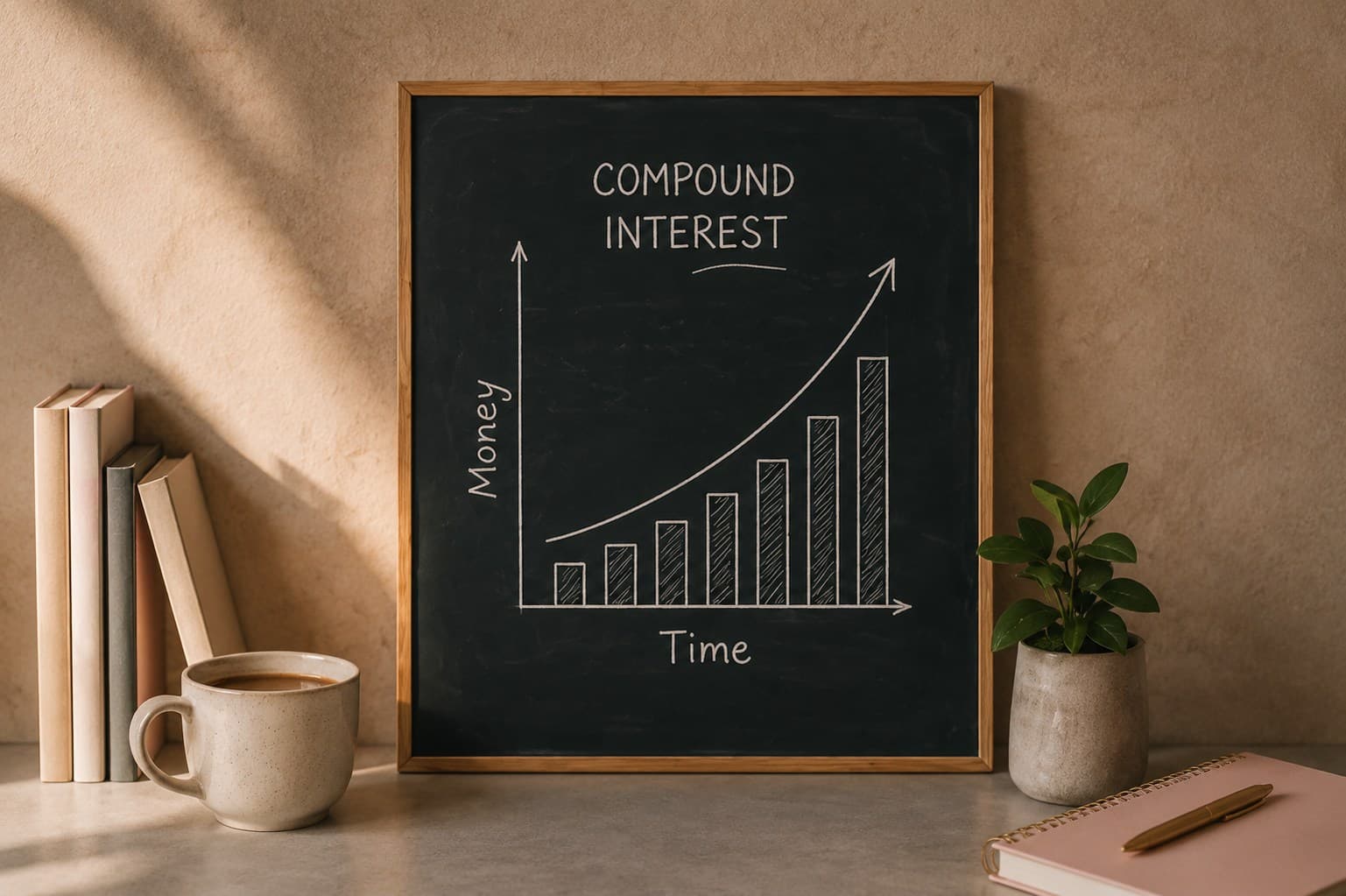
Compound interest is often called the eighth wonder of the world for a reason. Here's a clear explanation of how it actually works, with real numbers.

What Financial Independence Actually Means (And How to Get There)
Financial independence isn't one magic number or an early retirement fantasy. Here's what it actually means, and a realistic path toward it.